



What does employee experience mean?
Employee experience is defined by all the interactions between an employee and their employer throughout their time at an organization. For example, interactions include an employee’s first contact during the hiring process through to when they leave or retire.
A great employee experience can significantly impact an employee’s outlook on and relationship with your company. Furthermore, each stage of an employee’s life cycle is affected by the employee experience. So, during the recruitment process, it is important to make the candidate feel like they belong and align with your organization’s culture.
Once new hires sign on, employers should welcome them with an organized and well-planned onboarding experience. Organizations must then continue to provide their employees with an engaging and supportive environment each day, encouraging them to stay and do their best.
5 benefits of a great employee experience
Listed below are five reasons why your organization should prioritize the employee experience.
1. A great employee experience means lower turnover rates
High turnover rates are not ideal for any organization for a few reasons. For instance, it lowers morale among remaining employees and has a negative impact on customer service. Therefore, you should attract the best and most qualified candidates for your company.
When you dedicate the time and effort to find talented candidates, make sure you can attract and retain them by ensuring that the work they are doing is challenging and rewarding. That is to say, if they feel disengaged, they’ll move on.
2. Employees are more engaged
A great employee experience also means higher employee engagement rates. Engaged employees are excited and motivated to do their work. In fact, Bain & Company found that engaged employees are 44% more productive than those who are less engaged at work.
Employee engagement also results in a better customer service. Companies with engaged employees had 89% greater customer satisfaction. Additionally, better customer service results in better financial performance. A study done by the University of Pennsylvania concluded that organizations with higher-than-average employee engagement exceed the financial performance of their peers by 73%.

3. Employees are more productive
Employees who are happy and engaged due to a great employee experience are more productive. In essence, increased employee engagement leads to increased productivity.
When employees have a good employee experience, they want to do their work well and are interested in putting in the time and effort required to perform their duties better. What’s more, Gallup cites that companies with an engaged workforce outperform companies with disengaged workforces.
4. Stronger organizational culture
Organizational culture plays an important role in achieving a great employee experience. As a matter of fact, you might even say that culture is the employee experience. This is because culture goes beyond a set of values or mission statement. It includes all the traits and behaviours that make your company unique.
Furthermore, there’s an obvious difference between a company that has employees who are excited about coming into work each day and workplace that feels uninviting and uncomfortable. So, by providing a great employee experience, this naturally leads to an alignment between an high-performing workforce and an equally strong culture.
5. Communication improves between management and employees
Communication can have a huge impact on whether you are achieving a great employee experience or not. Employees want to know what tasks they are responsible for completing when it comes to work. However, they’re often overwhelmed with how many meetings are scheduled and the endless approval processes to get anything done. So, management needs to find an effective way to regularly communicate with their employees. Employees should feel supported by their managers and team leaders to help them succeed on the job.
- Benefit: Lower turnover
- Talented people stay when the work is challenging and rewarding; turnover lowers morale and hurts customer service
- Benefit: More engagement
- Engaged employees are motivated and give better customer service, which feeds financial performance
- Benefit: More productivity
- People who enjoy the experience want to do the work well and put in the effort
- Benefit: Stronger culture
- Culture is the employee experience: all the traits and behaviours that make the company unique
- Benefit: Better communication
- Managers communicate regularly and clearly about responsibilities instead of endless meetings and approvals
| Benefit | How it comes about |
|---|---|
| Lower turnover | Talented people stay when the work is challenging and rewarding; turnover lowers morale and hurts customer service |
| More engagement | Engaged employees are motivated and give better customer service, which feeds financial performance |
| More productivity | People who enjoy the experience want to do the work well and put in the effort |
| Stronger culture | Culture is the employee experience: all the traits and behaviours that make the company unique |
| Better communication | Managers communicate regularly and clearly about responsibilities instead of endless meetings and approvals |
Figures as the post cites them: Bain & Company, engaged employees 44% more productive; University of Pennsylvania, higher-than-average engagement exceeds peers' financial performance by 73%.
Frequently Asked Questions
What is employee experience?
Employee experience is the sum of every interaction between an employee and their employer, from first contact in the hiring process to the day they leave or retire. It covers recruitment, onboarding and the daily working environment. Each stage shapes how the person sees the company and how much of themselves they bring to the work.
Why does employee experience matter?
A good employee experience lowers turnover, raises engagement and productivity, strengthens the organizational culture and improves communication between managers and staff. Engaged employees also give better customer service, and Bain & Company, Gallup and the University of Pennsylvania have all tied engagement to stronger business results.
How does employee experience affect turnover?
High turnover lowers morale among the people who stay and hurts customer service. Candidates who were hard to recruit will leave if the work is not challenging and rewarding, so the experience has to hold up after the hiring stage: a well-planned onboarding, then an engaging, supportive environment every day. People who feel disengaged move on.
What is the link between employee experience and company culture?
Culture is more than a values statement; it is all the traits and behaviours that make a company what it is, which is why some say culture is the employee experience. The gap between a workplace people are excited to come to and one that feels uninviting is obvious. A good experience lines up a high-performing workforce with an equally strong culture.
How can management improve the employee experience?
Communicate regularly and clearly. Employees want to know what they are responsible for, but they are often buried in meetings and approval steps. Managers and team leaders should make people feel supported, start with an organized onboarding, keep the work challenging and rewarding, and recognize contributions. Recognition and employee voice are the two biggest drivers.
How LeanSuite can help
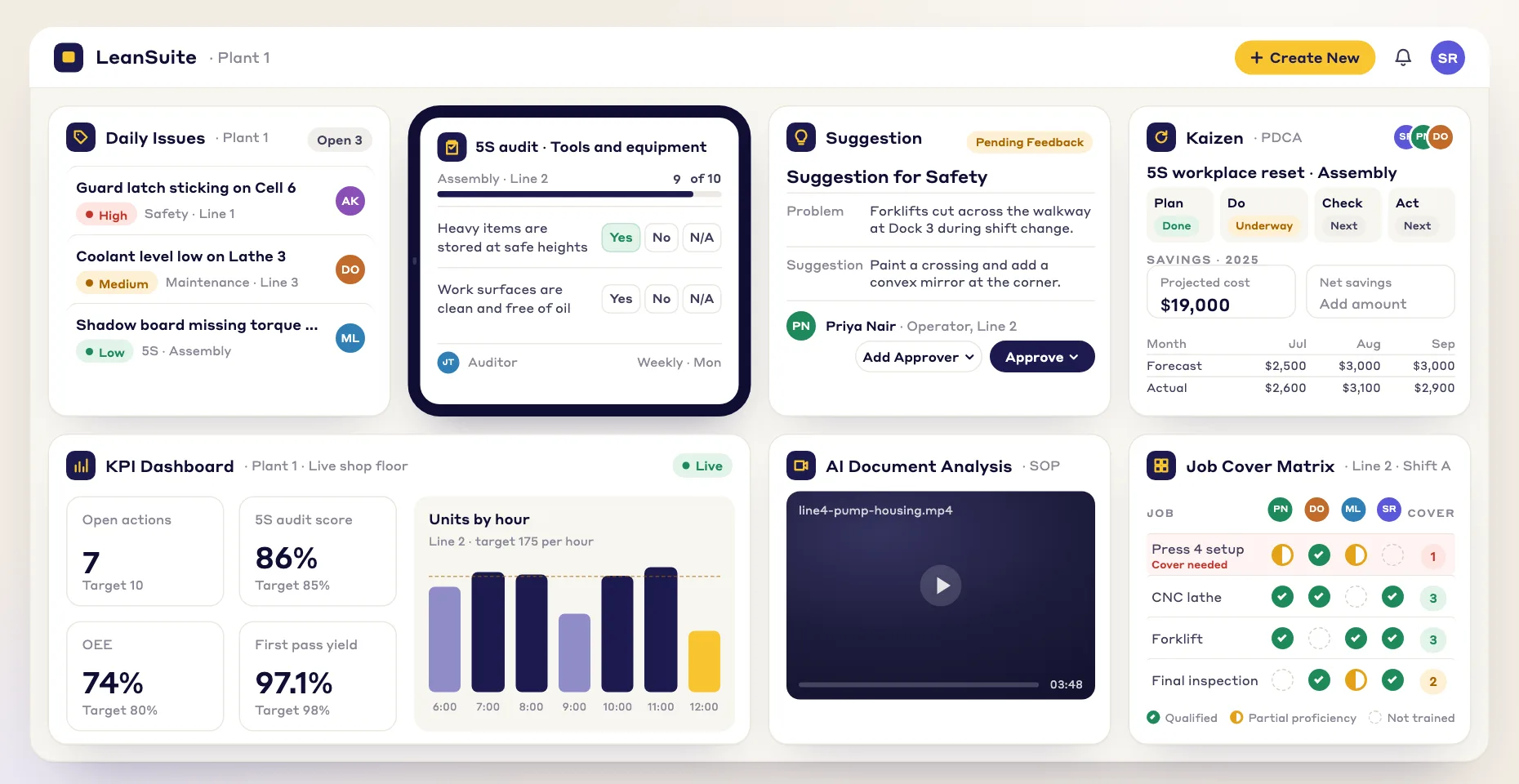
The two biggest drivers of employee experience are recognition and employee voice. LeanSuite is a lean manufacturing software that features the Idea Management System. Essentially, it is an employee engagement platform that allows employees to freely provide ideas and feedback that may help internal processes. It also has a built-in recognition and reward system that is designed to provide employees with frequent social and monetary recognition.
Free for this topic: Leader standard work template, Gemba walk checklist, Lean maturity self-assessment
Want our lean manufacturing guides first in Google? Add us as a preferred source.
Add LeanSuite as a preferred source on Google (opens in a new tab)


