
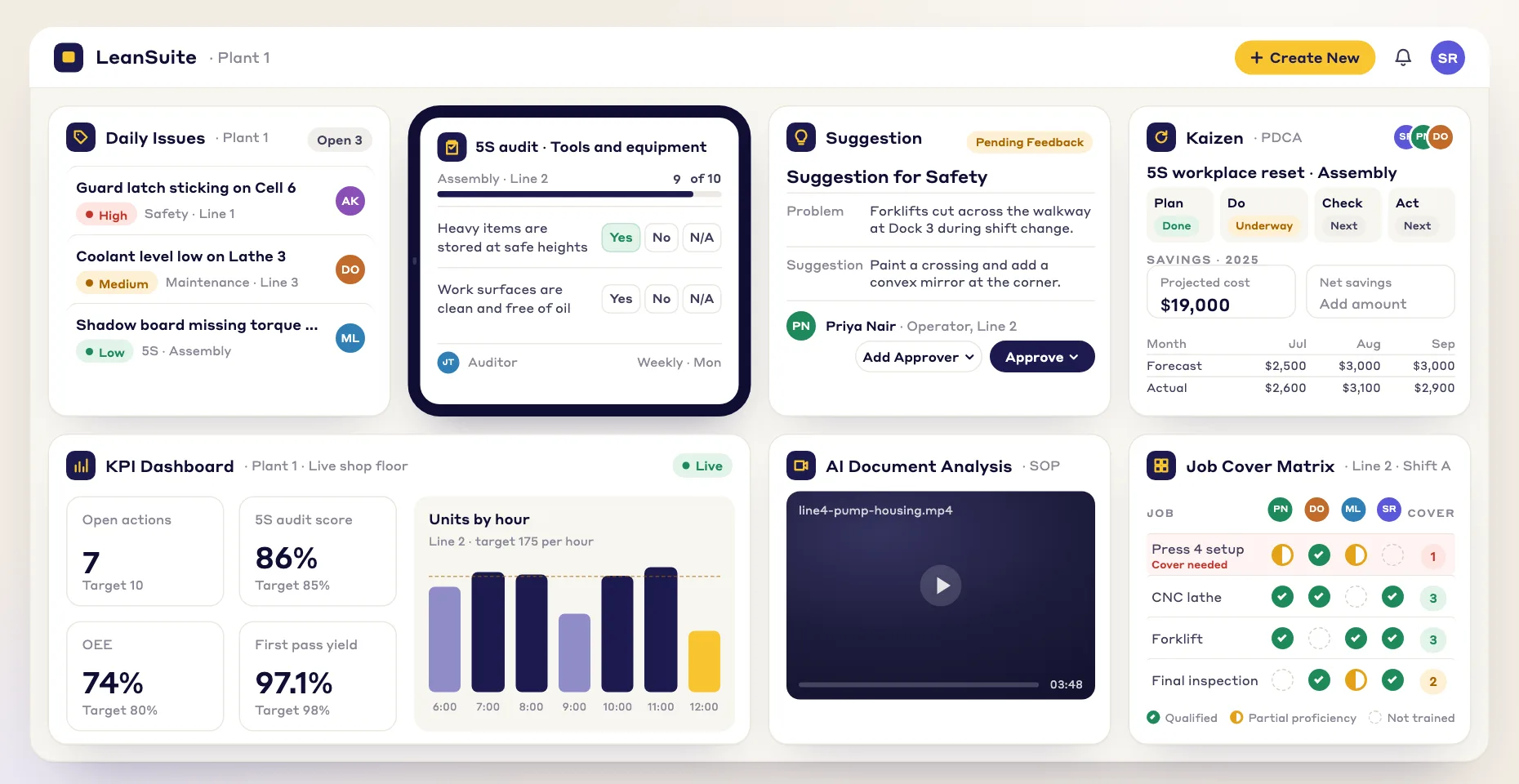
The old way
The paper trail problem
Paper checks get done unevenly, nobody sees them until the end of the shift, and small problems grow into breakdowns.
Digital CILR checklists put each machine's clean, inspect, lubricate and retighten routine on the operator's Daily Standard Work in LeanSuite, so small problems are caught before they become breakdowns.
By clicking "Schedule Demo," you agree to the use of your data in accordance with LeanSuite's Privacy Notice, including for marketing purposes.
TRUSTED BY INNOVATIVE LEADERS
CILR, explained
CILR is short for clean, inspect, lubricate and retighten: the basic care operators give their own machines in TPM autonomous maintenance. Some plants say CIL or CILT instead. In the usual seven steps of autonomous maintenance, step 3 is where operators write provisional standards for this care: which points to clean, check, lubricate and tighten, how, how often and who does it, within a time the shift can afford.
| Point | Task | Method | OK condition | Interval | Time |
|---|---|---|---|---|---|
| Glue nozzle guard | Clean | Wipe with a lint-free cloth, machine stopped and locked out | No glue build-up on the guard | Every shift | 2 min |
| Vacuum gauge | Inspect | Read the gauge while the machine runs | Needle in the green band | Every shift | 0.5 min |
| Gearbox sight glass | Inspect | Look at the oil level, machine stopped | Oil between the two marks | Daily | 0.5 min |
| Sensor bracket bolts | Retighten | Check the match marks; if a mark has moved, retighten and tag the bracket | Match marks line up | Daily | 1 min |
| Drive belt | Inspect | Press at mid-span, machine stopped and locked out | Deflection within the marks on the tension label | Weekly | 2 min |
| Chain drive | Lubricate | The lubricant and amount on the point's label, machine stopped and locked out | Label present, thin film on the chain, no fling-off | Weekly | 3 min |
Illustrative, not a standard for any real machine: the points, limits, lubricants and intervals come from the machine's manual and your maintenance team, and checks with the machine stopped follow its lockout procedure.
Add up the time to see the operator's load: here 2.5 minutes every shift, 1.5 minutes a day and 5 minutes a week. Anything abnormal gets a tag, and goes to maintenance when the fix is beyond what the standard lets the operator do. In step 5 the provisional standard becomes the machine's final standard once the team knows which checks matter. Start from the 20 checks in the free autonomous maintenance (CILR) checklist and the lubrication schedule.
THE OLD WAY VS. THE LEANSUITE WAY
The paper trail problem
Paper checks get done unevenly, nobody sees them until the end of the shift, and small problems grow into breakdowns.
A pillar of reliability
Daily equipment care becomes part of each operator's standard work, with live completion, so problems are caught at the source.
HOW IT WORKS
Digitize the CILR standards you already have and get them to operators in four steps.
DAILY STANDARD WORK
Daily Standard Work is where LeanSuite schedules and tracks the checklists, audits, SOPs and OPLs assigned to each person, role or machine.
Assign a check to an asset instead of a person, and whoever runs that machine sees it on their calendar.
Assign to a role for everyone in it, or for any one person to complete, with repeat rules and an end date.
Operators see overdue, in-progress, upcoming and submitted checks as cards, and missed items stand out in red.
Require a photo or comment on an answer, ask a follow-up question, flag it, or raise a tag automatically.
Describe the machine or upload your paper or Excel checklist, and AI drafts the digital version for you to edit.
One report lists every flagged answer across checklists, so repeat problems on a machine are easy to see.
A COMPLETE CILR SOLUTION
A CILR program that tracks who did what and improves the standard over time.
REAL-TIME ACCOUNTABILITY
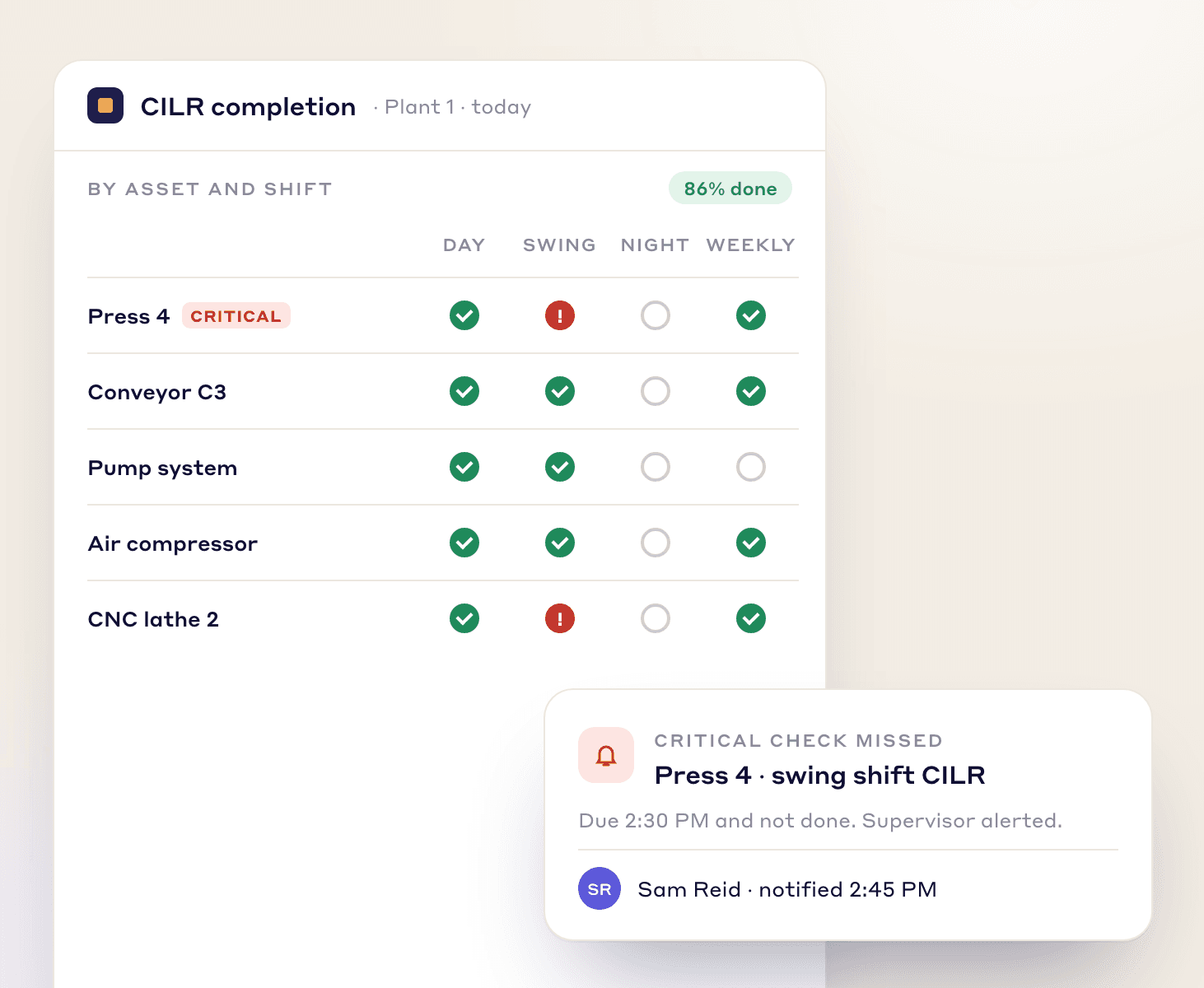
Mark key checks as critical and get an automatic alert when one is missed, so gaps are closed the same shift.
SYSTEMIC IMPROVEMENT
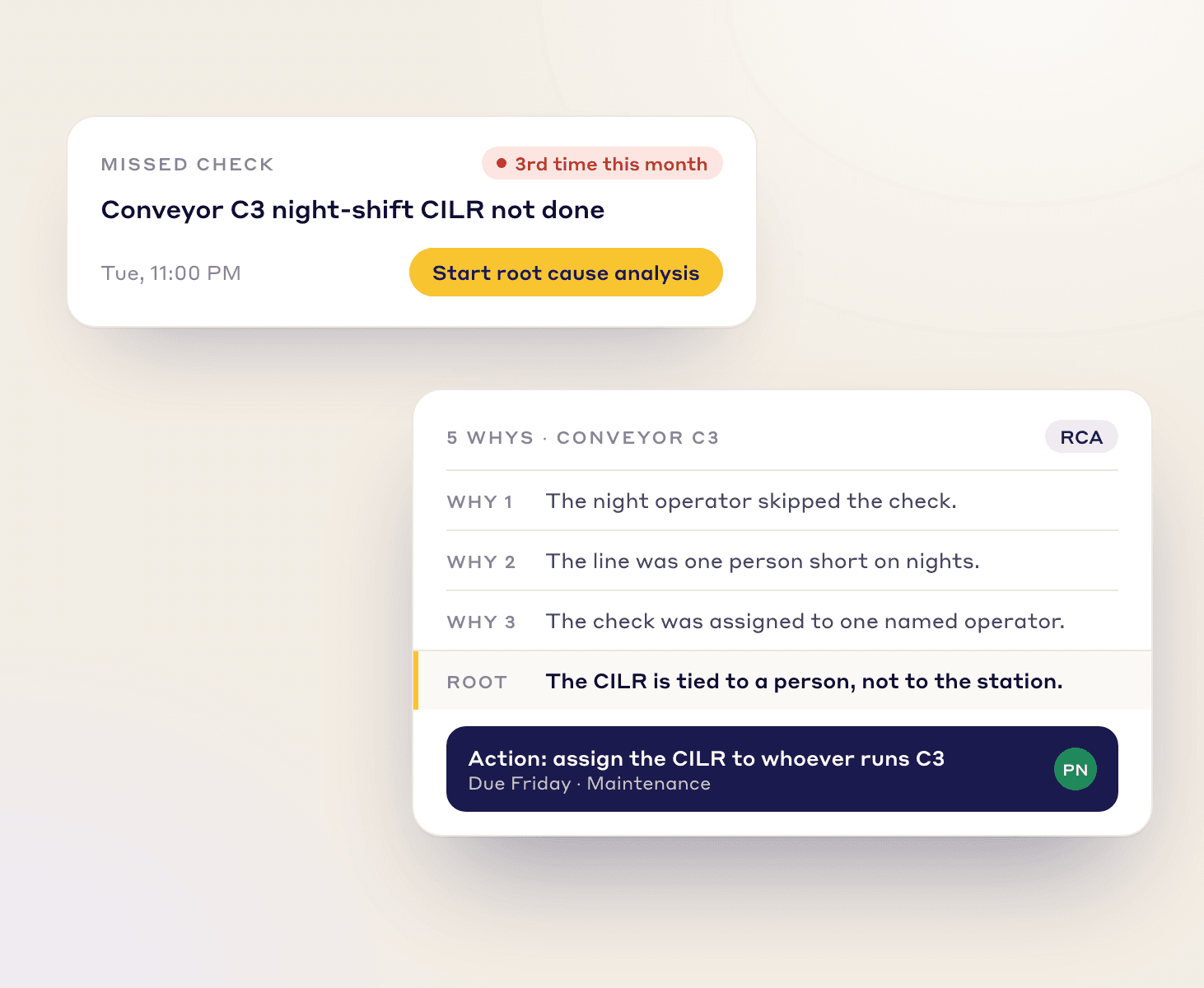
When a check is missed, start a root cause analysis from the alert and assign an action plan so it doesn't happen again.
DATA-DRIVEN DECISIONS
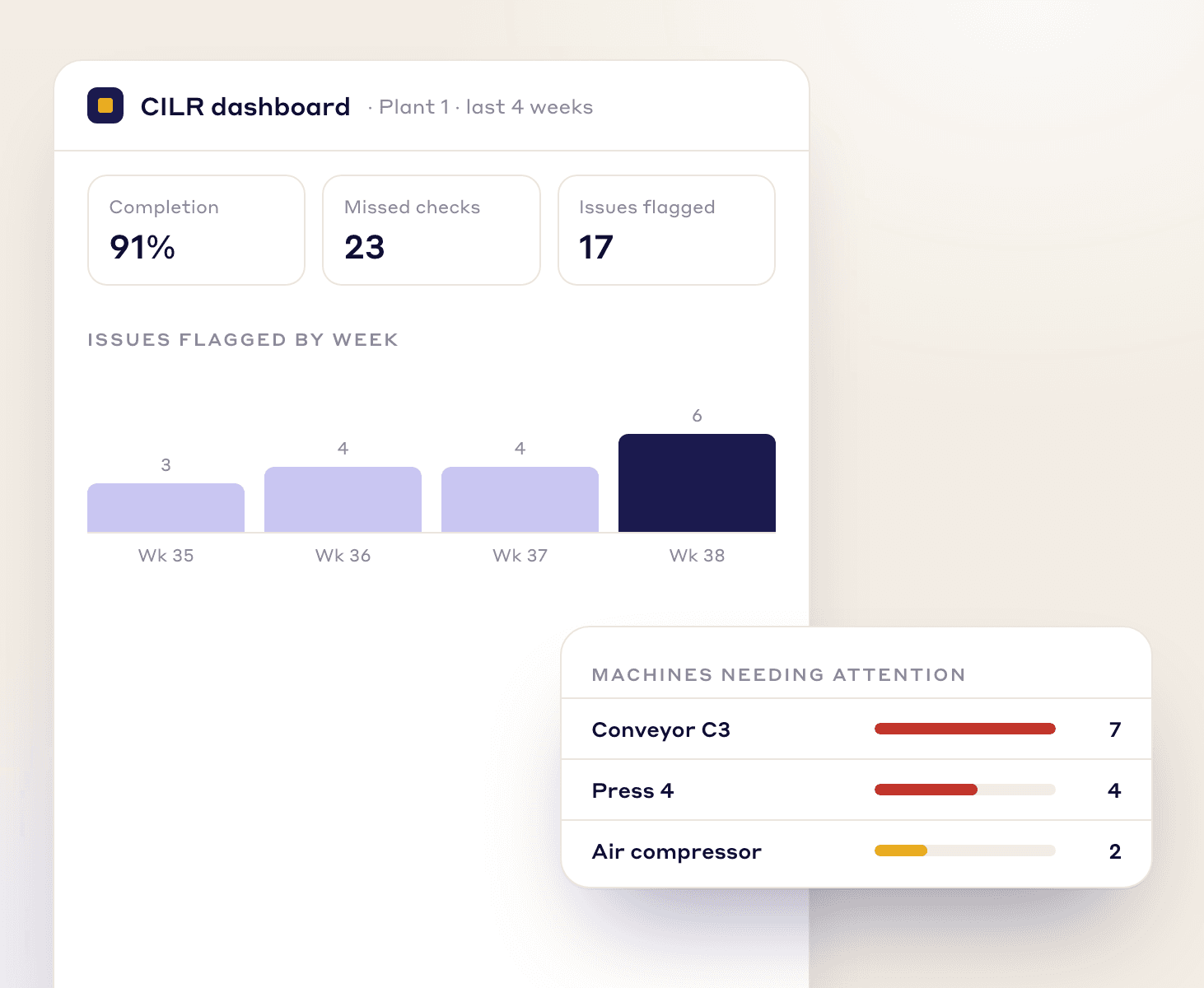
Check data feeds dashboards showing completion rates, issue trends and the machines that need the most attention.
ENSURE QUALITY & SAFETY
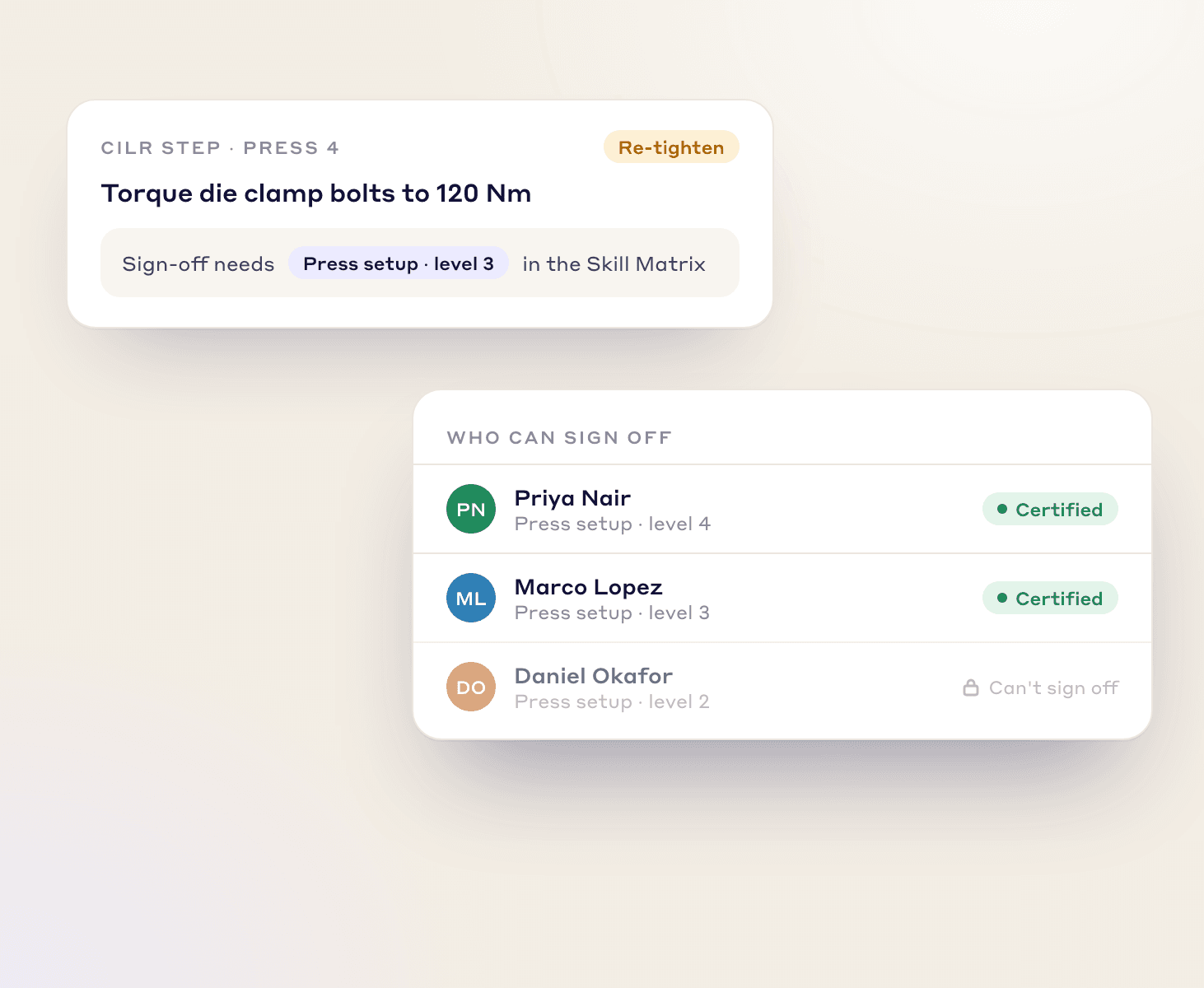
Link critical or complex CILR tasks to competencies in your Skills Matrix, so only certified operators can perform and sign off on them.
CLOSE THE LOOP
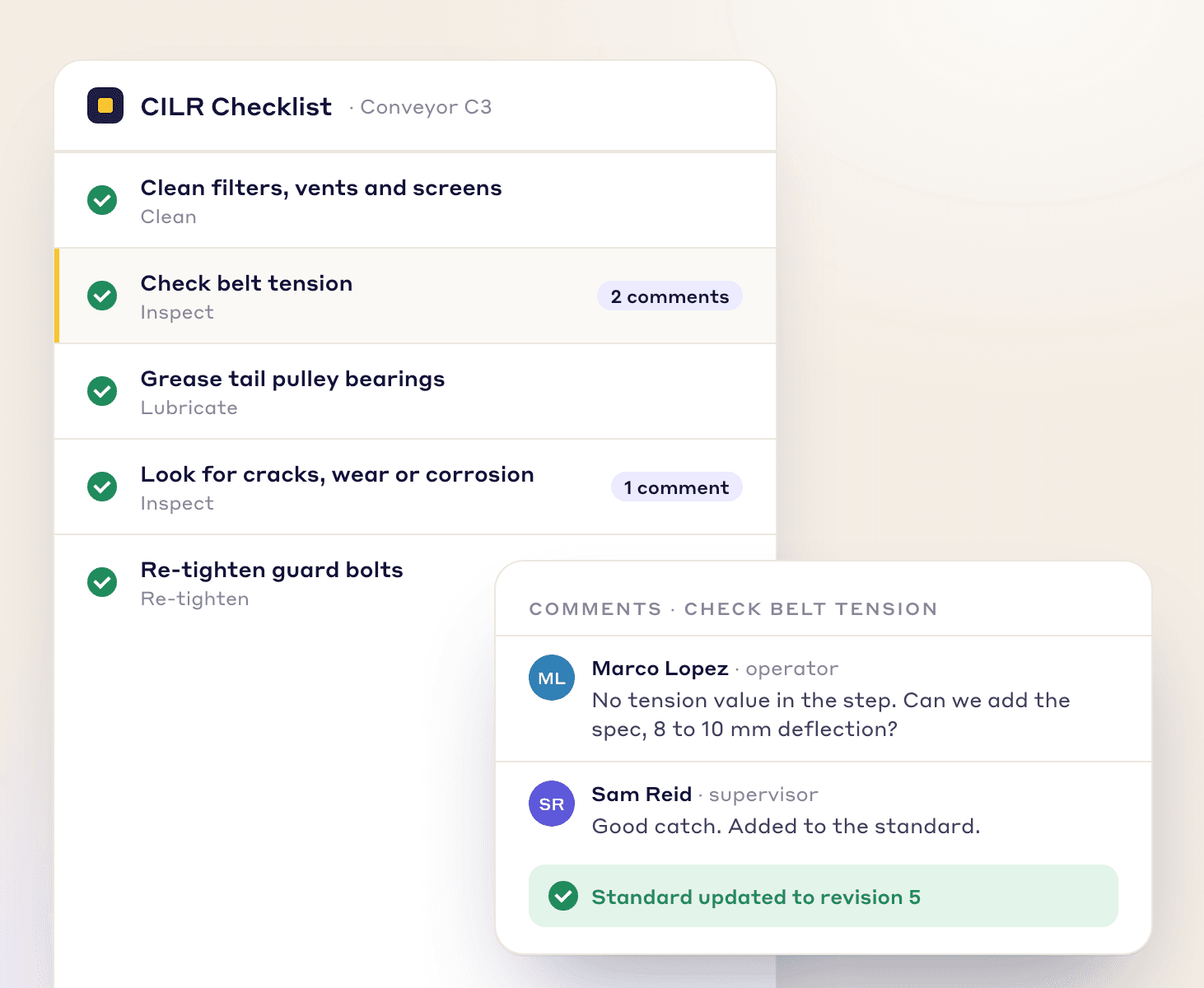
Operators know the machines best. They can comment on any checklist step, and those comments feed back into better standards.
END "PENCIL-WHIPPING"
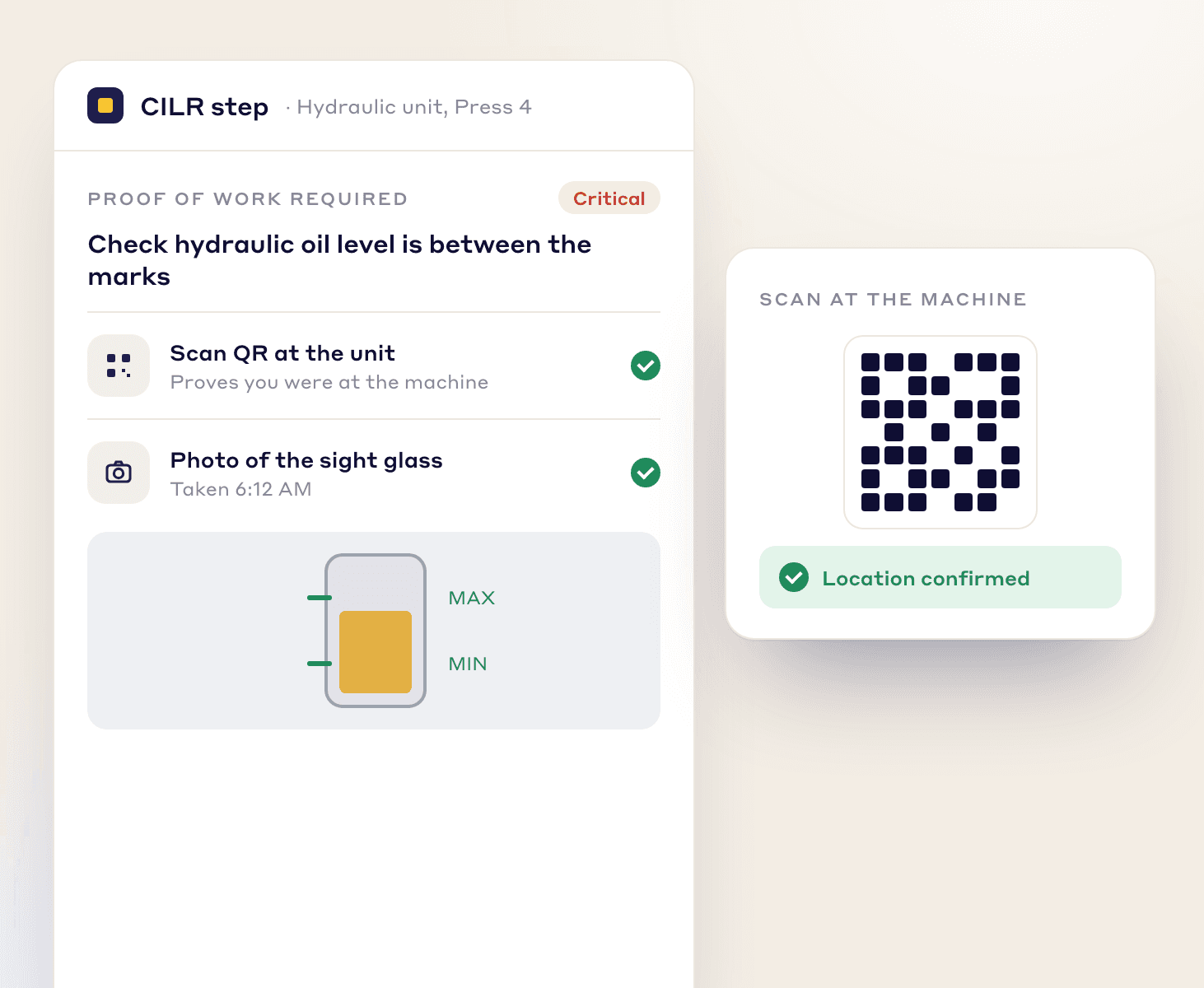
Require a QR scan at the inspection point or a photo as proof, so critical tasks are shown done to standard, not just ticked.
SINGLE SOURCE OF TRUTH
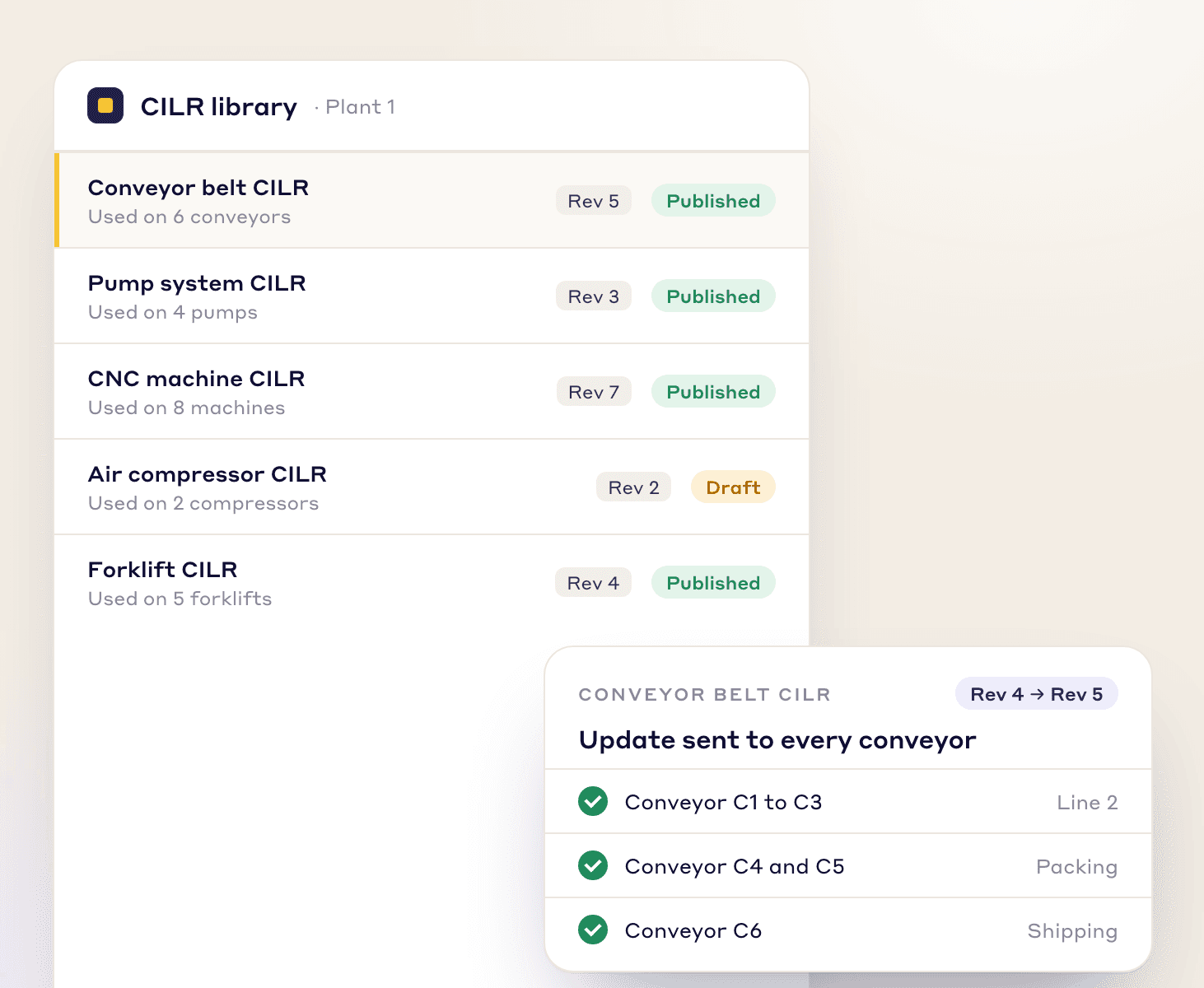
Keep every CILR checklist in one library. Update a standard once and every machine that uses it gets the new version.
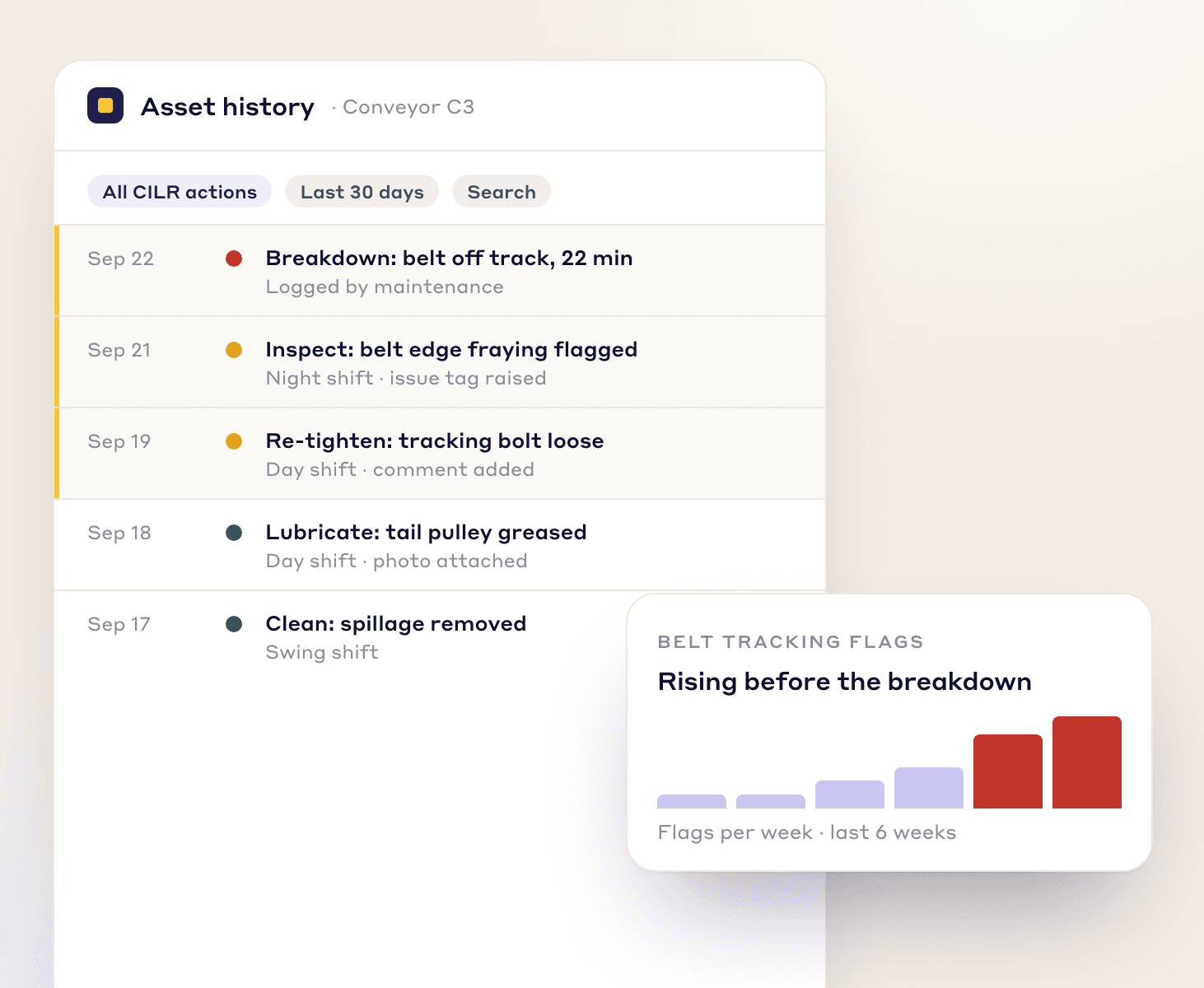
ACCELERATE PROBLEM-SOLVING
Every CILR action is saved in a searchable log for each asset, so after a breakdown you can review its history and find the cause faster.
FAQs
CILR stands for clean, inspect, lubricate and retighten: the four basic equipment care tasks operators carry out as part of autonomous maintenance. Each machine gets a CILR standard that says which points to check, how and how often, which catches loose fasteners, leaks, contamination and wear before they turn into breakdowns.
It depends on the machine and the task: some points need a check every shift, others weekly, and each machine's CILR standard sets the frequency. In LeanSuite you set that frequency as a repeat rule in Daily Standard Work.
Daily Standard Work shows, schedules and tracks the checklists, audits, SOPs and OPLs assigned to each person, role or machine. Operators see their checks on a calendar or Kanban board, and missed items show in red.
Yes. Assign the checklist to an asset, and whoever runs that machine sees it on their calendar. You can also assign it to a role, for everyone in it or for any one person to complete.
Nearly. CIL stands for clean, inspect and lubricate; CILR adds retighten, for the bolts and fittings that work loose. Both name the same operator routine in autonomous maintenance, and LeanSuite schedules either one the same way.
Yes. Operators can comment on any step of a CILR checklist, which captures frontline knowledge and improves the standard over time.
CILR is the first check. When an operator flags an issue during a CILR check, it can raise a tag or work request for your maintenance team in Daily Issue Management.
Yes. The autonomous maintenance (CILR) checklist at theleansuite.com/templates/autonomous-maintenance-checklist and the lubrication schedule at theleansuite.com/templates/lubrication-schedule-template are free as PDF and Excel.
FREE RESOURCES
Not ready for software yet? Start with these free resources.
See how LeanSuite digitizes daily equipment care and helps your frontline team keep machines running.