
Ranked by tags closed
The board rewards whatever closes fastest, so housekeeping tops the list and the review meeting sounds good. You were about to put a team on another housekeeping push.
Closed, then back
Someone marked the job done, nobody checked whether the cause was actually gone, and the same issue returns under a new number. LeanSuite keeps the issue alive until a person verifies it and the cause is dealt with.
By clicking "Schedule Demo," you agree to the use of your data in accordance with LeanSuite's Privacy Notice, including for marketing purposes.
TRUSTED BY INNOVATIVE LEADERS











Two ways to rank
The same four issue categories, ranked by how many tags you closed and by how often the same thing came back. The list flips.
The board rewards whatever closes fastest, so housekeeping tops the list and the review meeting sounds good. You were about to put a team on another housekeeping push.
Rank the same four by how often they come back and breakdowns sit at the top, even though barely any of them close. That is where the Kaizen and the root cause work belong.
Sound familiar?
You get a tag about a leak, someone wipes it up, and the tag is marked done. Two weeks later the same leak is written up again by a different operator on a different shift. Without a CAPA effectiveness check, the repeat never looks like a failure on the board; it looks like a brand new issue. Meanwhile the tag that nobody wants keeps getting reassigned back and forth between safety and operations until it just sits there. Nobody is lying; nobody ever checked whether the cause was actually dead.
Tags bounce between departments
If a tag came to me and I'm a safety supervisor, I would reassign that tag back: this is not my task, operations need to take care of this. It was getting reassigned all the time and the tags weren't getting closed.
Closed on paper only
The job is marked done and nobody is asked whether the condition stayed gone a week later.
The board looks healthy
Closure counts climb while the same machine keeps generating the same write-up every month.
Verification before complete
Once they're done with this, they can hit submit and say this job is done. The supervisor or the pillar leader receives a notification and they can simply mark it as complete or send this back if there's any issues with it to reopen it.
Reassignment locks after three
You can configure that. Only allow the reassignment however you want to set it up, three times. After three times, the system will lock the reassignment and send notification to their manager that take a look at this tag.
Repeats become a Kaizen
You could initiate a Kaizen out of it, and the system can help you with doing the RCA in a more automated way and gives you countermeasures which you can implement right away. If you want the system to validate some of the things inside any document, be it Kaizen, you could have the system check that, so when someone's trying to make the transition, it will prompt them that they didn't fill out this field.
Read your own floor
None of these show up as a failure on the board, which is exactly why they last.
If several of these are true, you are closing tasks rather than causes.
How it works
The idea is that everything is in one place. It brings pretty much all those small little systems that you have in place and brings it all together into one central hub for all things Lean related. And let's say if there's a bigger issue that happens on the shop floor, then the Kaizen comes in where you could do the root cause analysis.
Step 1
You'll be able to simply scan that QR code and the system will pick up all your area, line, workstation and machine information. If you're using your phone, you can take an image as well and you can simply add that, and you hit create. So it's as simple as that. Now this tag gets created and it gets routed to the right person, whoever it needs to go to from there.
Step 2
Now you can configure that. Only allow the reassignment however you want to set it up, three times. After three times, the system will lock the reassignment and send notification to their manager that take a look at this tag. Because if you leave it like this, it's not going to get closed.
Step 3
Once they're done with this, they can hit submit and say this job is done. Now the supervisor or the pillar leader can receive a notification, and they can simply mark it as complete or send this back if there's any issues with it to reopen it. Or they can simply talk to them in the comments section, and they can also add that individual who submitted the tag initially.
Step 4
There's a built in tag report. You can track which asset is costing you the most, and the status by tag type and priority. Let's say if there's a bigger issue that happens on the shop floor, then the Kaizen comes in where you could do the root cause analysis. You can assemble a team, you can add description, you can do the 5W1H, you can set up targets.
If nothing changes
The loss does not disappear when the tag does. It just goes back to being invisible.
The job is logged complete, the closure count ticks up, and nobody is asked to check it later.
A different operator on a different shift writes up the same condition as a brand new issue.
The tag has changed hands twice and the history of the first fix is gone with it.
People stop reporting it, because reporting it has never once changed the condition.

From our co-founder
“Usually an OPL is a very short term solution; longer term it should become part of the work instructions, or it requires a Kaizen, because it still happens.”
Where to go next
A closed tag only stays closed if the issue was tracked properly, the cause was actually found, and the change reached the next shift. These three pages cover those steps.
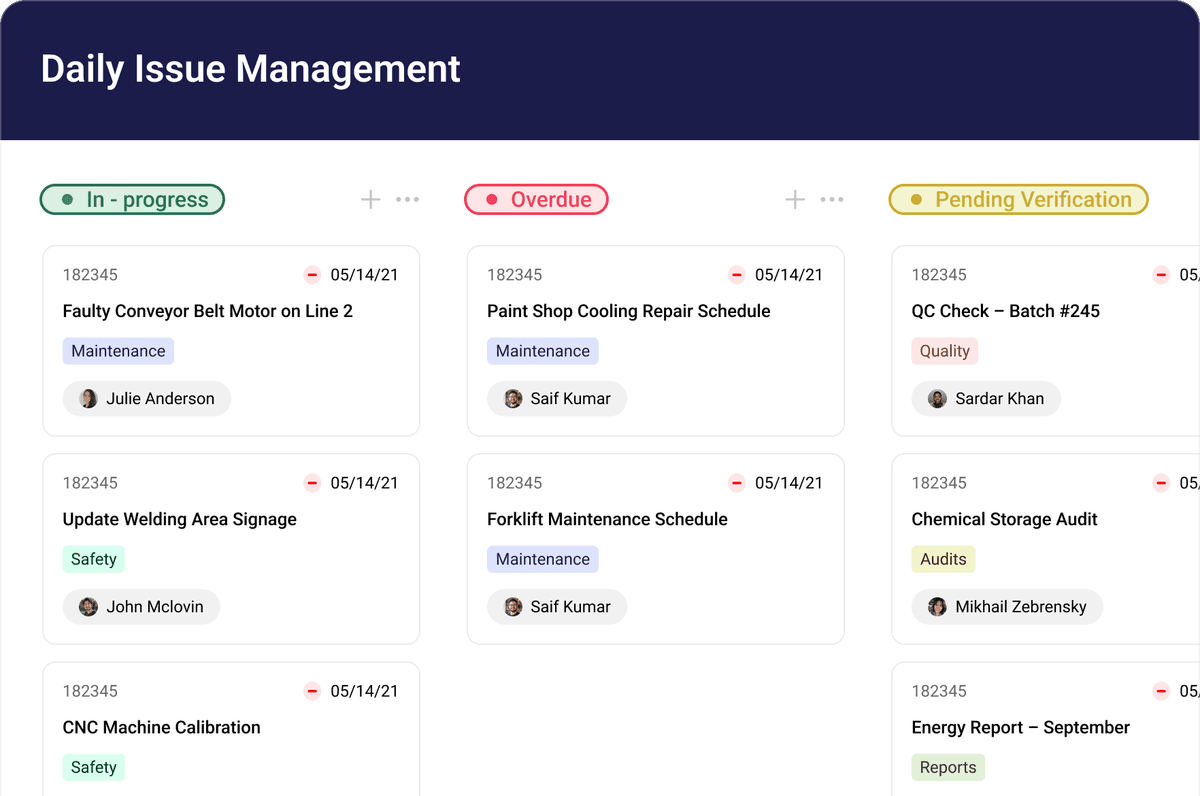
Gives the frontline one place to flag, track, and resolve issues instead of loose tags. The second write-up of the same leak lands in the same record as the first.
See how it works →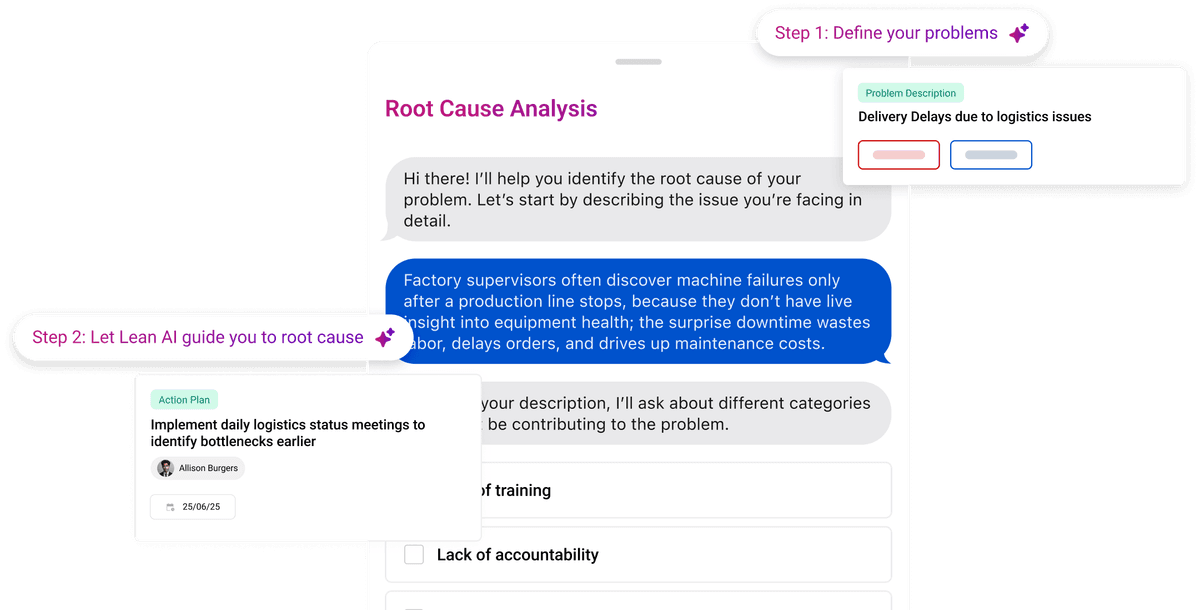
Walks your team through RCA step by step instead of stopping at wiping up the leak. You close the tag knowing what actually caused it, not guessing.
See how it works →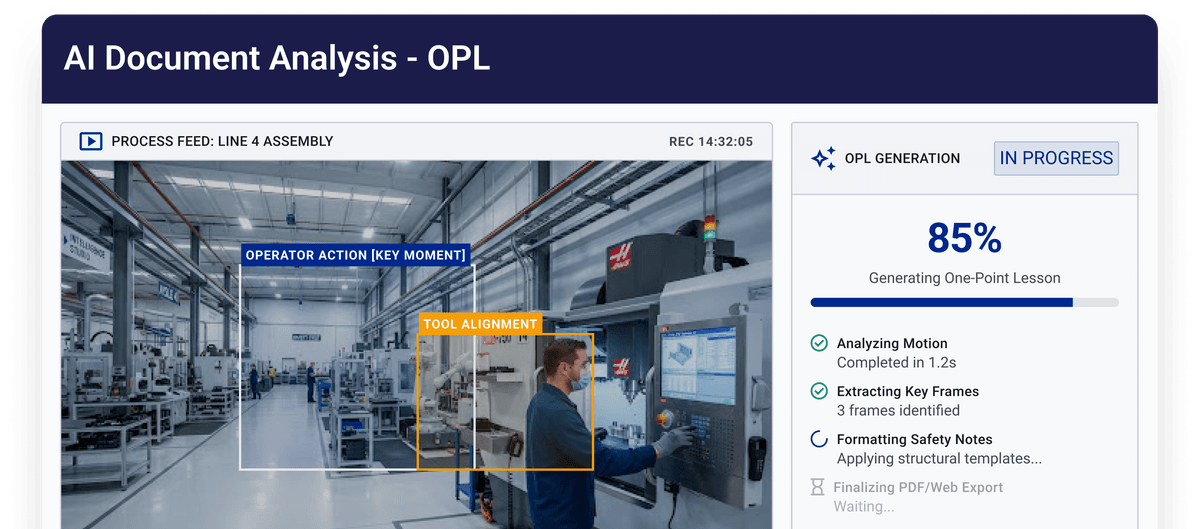
Builds One Point Lessons that turn what you learned into simple visual instructions. Every shift works the same way, so the problem doesn't come back with the next crew.
See how it works →Bring one problem your plant has closed twice and we'll walk it through capture, verification, the reassignment lock and the Kaizen on screen.