
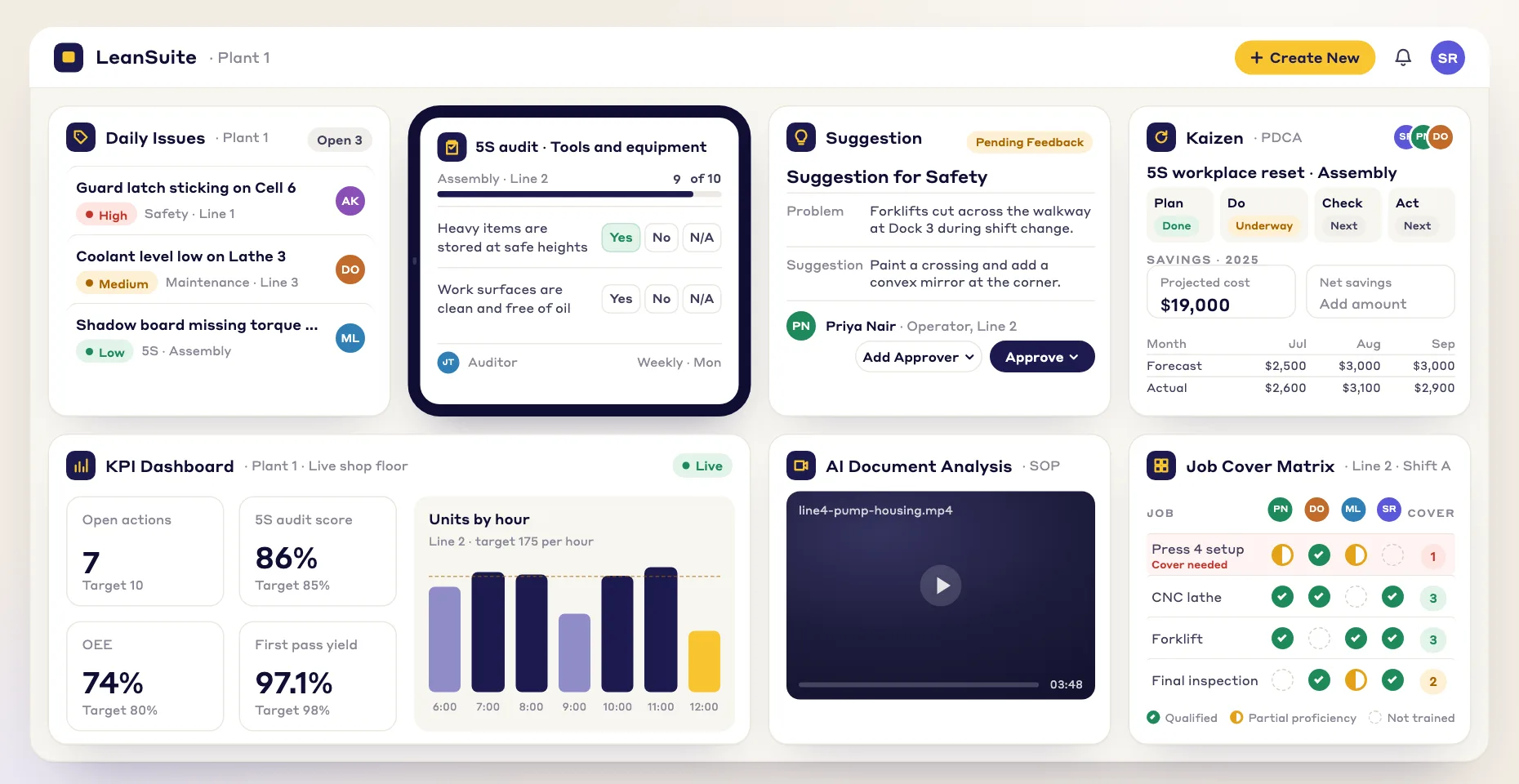



A continuous improvement culture is a shared mindset in which employees want to get a little better every day through small, incremental improvements. It starts with leaders, because people will not commit to an initiative they see their leaders ignore, and every suggestion needs a quick answer, even the bad ones.
In today’s blog, we’ll be discussing how to foster a continuous improvement culture. According to the McKinsey Organizational Health Index, a continuous improvement culture is one of the most important ingredients for a healthy organizational culture. But, before we get into how you can foster a continuous improvement culture, let’s first discuss what continuous improvement is and what a continuous improvement culture is.
What is continuous improvement?
Continuous improvement involves continuously striving for perfection in everything you do. In Lean management, continuous improvement is also referred to as Kaizen. Moreover, it aims to improve every process in your company. This is done by eliminating wasteful activities (tackling the 3M’s) and enhancing activities that generate the most value for your customer.
What is the continuous improvement culture (CIC)?
The continuous improvement culture is the change in how employees think about their work. Essentially, it is a mindset that makes people want to become better every day, through continuous incremental improvements. There are four key benefits of fostering a continuous improvement culture:
Achieve operational excellence
Operational excellence in manufacturing generally means applying lean manufacturing techniques. In essence, it involves employees, at all levels, to work towards improving business operations. As a result, businesses can achieve long-term sustainable growth and profitability. So, a continuous improvement culture plays an integral role in achieving operational excellence. This is because once it is implemented and absorbed into an organization, it becomes its DNA.
While a continuous improvement culture supports operational excellence, in return, operational excellence reinforces the mentality ingrained in the culture that enables the workforce to continuous improve.
Become more innovative
Continuous improvement is one of the building blocks of incremental and sustaining innovation. What’s more, the continuous improvement culture is the foundation of the Toyota Way — a set of guiding principles that Toyota has developed to continuously empower their employees to identify improvement opportunities for their products.
However, only suggesting new ideas is not enough to make innovation happen. Instead, it is how those ideas are prioritized, managed, and implemented that moves things forward. In short, Toyota has successfully proved that fostering a continuous improvement culture is what greatly impacts how innovative a company can become.
Increase employee retention and employee engagement
Employee engagement has become a major focal point for many organizations. As the newer generations have different incentives and expectations from their workplace, companies fight to attract and obtain the best talent. So, this is where corporate culture comes in.
Nowadays, employees are not only paying attention to perks and benefits, but they are also paying attention to the culture of the company they are interested in working for. Therefore, if your employee engagement rate is low and employee turnover rate is high, ask yourself (and then your employees too) these questions:
- Do they have any development opportunities?
- Can they grow as professionals and individuals?
- Do they align and relate with the company’s core values?
- Are they recognized and appreciated? And is their work recognized and appreciated?
If you successfully address these concerns, then you are on the right track.
Do they have any development opportunities?
Can they grow as professionals and individuals?
Do they align and relate with the company's core values?
Are they recognized and appreciated?
And is their work recognized and appreciated?
The post says to ask yourself first, then your employees.
Gain a competitive advantage
By not improving, you are not evolving. Therefore, in today’s highly competitive markets, it is extremely important to keep up and stand out or else you’ll fall behind.
You begin to gain a competitive advantage when your employees understand and are directly participating in the effort required to continuously develop. Cultural change empowers your employees.
Additionally, while a continuous improvement culture is led from top-down, it is implemented from bottom-up. As a result, front-line employees can only take ownership and be held accountable when management gives them responsibilities.
- Role
- Leaders:Lead by example, show commitment
- Frontline employees:Know the shop floor best
- Ideas
- Leaders:Ask for suggestions, do not dictate
- Frontline employees:Suggest improvements to processes, safety and customer experience
- Response
- Leaders:Follow up on every suggestion: approve or coach
- Frontline employees:Learn better solutions through coaching
- Ownership
- Leaders:Give responsibilities, time, resources and tools
- Frontline employees:Take ownership and are held accountable
| Aspect | Leaders | Frontline employees |
|---|---|---|
| Role | Lead by example, show commitment | Know the shop floor best |
| Ideas | Ask for suggestions, do not dictate | Suggest improvements to processes, safety and customer experience |
| Response | Follow up on every suggestion: approve or coach | Learn better solutions through coaching |
| Ownership | Give responsibilities, time, resources and tools | Take ownership and are held accountable |
7 steps to foster a continuous improvement culture
Fostering a continuous improvement culture that sticks isn’t always easy. Some strategies may work in the short-term, but if they’re not followed consistently, then the continuous improvement culture will die out. However, there are several fundamental steps you can take to instil cultural change that lasts for the long-term:

1. Lead by example
To effectively foster a continuous improvement, you need to lead by example. As mentioned previously, a continuous improvement culture is lead from the top-down. So, if your employees see that your leaders aren’t committed to an initiative, then they won’t feel encouraged to follow it. But, if your leaders set the correct tone by demonstrating their commitment and involvement to an initiative, then your employees will be more likely to respect an initiatives value, and follow their leaders.
2. Collect employee suggestions
Instead of dictating the new initiatives to be implemented, collect suggestions from your employees. By doing this, your employees will respond more positively towards the new initiatives, and it encourages them to engage from the very beginning. In fact, according to the Harvard Business Review, people resist change when it is imposed on them. Therefore, choose an approach to your improvement activities that is more collaborative.
Your frontline employees know your shop-floor and operations best. So, you’ll benefit from the different perspectives and collective intelligence of your entire workforce. What’s more, collecting suggestions from your employees is one of the most effective ways to boost employee engagement.
3. Be open-minded
While it might be tempting to only collect suggestions that directly address your profitability or return on investment (ROI), your organization thrives on more than just these numbers. Hence, to effectively foster a continuous improvement culture within your organization, be open-minded when considering improvement suggestions. Instead of focusing on your bottom line, ask for suggestions that can:
- Improve your processes
- Make your employees’ jobs easier, safer, or better in some way
- Improve your customers’ experience
When you’re open-minded and welcome all types of suggestions, you’ll see improvements across your organization, including financial benefits.
4. Provide instant feedback
Once you collect suggestions from your employees, it is important that you follow up on all of them right away — even the bad ones.
A good Kaizen coach knows that bad improvement suggestions might still lead to real improvement opportunities. They also take the time to coach their employees in discovering better solutions. Therefore, to foster a continuous improvement culture, make it a rule that all your leaders will provide instant feedback to all employee suggestions. They can either give approval to implement the suggestion or provide coaching to better identify another approach to solving an unidentified problem.
5. Make improvement easy
If you want to successfully foster a continuous improvement culture within your organization, then it’s vital to make it easy for your employees. Create a process that’s easy to follow by keeping it as simple as possible, and remove any potential barriers.
Two of the most common challenges that leaders face are lack of time and resources. So, your leaders will need to address this early on. Additionally, support your employees by providing them with the tools they need to make suggestions, track the progress of those suggestions, and then collaboratively execute the improvement projects.
Leveraging tools like an Idea Management System and a Kaizen and Project Management System is an effective way to collect suggestions and implement projects. This is because it integrates the entire improvement process under one central hub.
6. Recognize and reward your employees
Recognizing and rewarding your employees is fundamental to the long-term integration of a continuous improvement culture into an organization. In other words, doing this provides proof that your employee’s suggestions are working, and that their improvement efforts are valuable.
What’s more, this further boosts employee engagement, and motivates your employees to continue suggesting new improvement opportunities. Over time, this leads to continual innovation and continuously improves how your organization operates.
But, don’t forget that improvement starts with small, incremental changes before they build up to larger changes. Thus, ensure to recognize the little achievements along the way as this will encourage your employees to follow the culture.
7. Support cultural change
Fostering a continuous improvement culture within an organization requires a lot of time and the right support.
In general, change can be daunting for many people. Consequently, it’s up to your leaders to make this cultural change as smooth as possible. To do this, coach your leaders and employees so that they know how to use relevant tools, helping them to not be put off by a lack of knowledge. Additionally, you can create an organization-wide library of improvement suggestions and solutions so that everyone has access and can learn from best practices.
One of the easiest ways to support cultural change is to leverage digital tools. From collecting employee suggestions for improvement opportunities to tracking the progress of various projects, an Idea Management System and the Kaizen and Project Management System can streamline and simplify the entire process.
- 1
Collect suggestions
From the people who know the work, instead of dictating - 2
Give instant feedback
Every suggestion, even weak ones: approve or coach - 3
Implement
Simple process, time, resources and tools to track progress - 4
Recognize and reward
Including small wins, as proof the effort matters
Recognition motivates the next round of suggestions.
Frequently Asked Questions
What are the benefits of a continuous improvement culture?
Operational excellence, more innovation, higher employee retention and engagement, and a competitive advantage. The common thread is that improvement becomes part of how everyone works, from the front line up, rather than a short-term push that fades when nobody follows it consistently.
How do you get employees to participate in continuous improvement?
Collect their suggestions instead of handing down initiatives. People resist change imposed on them, and your frontline staff know the shop floor best. Then respond to every suggestion right away, even the weak ones, with approval or coaching. Make it easy to submit and track ideas, and recognize the small wins, because that is proof the effort counts.
Is a continuous improvement culture top-down or bottom-up?
Both. It is led from the top down and implemented from the bottom up. Leaders have to set the example, because employees will not commit to an initiative their leaders visibly ignore. But frontline employees can only take ownership when management gives them real responsibility, so the daily improvements come from the floor.
What should you do with a bad improvement suggestion?
Follow up on it right away, like every other suggestion. A good Kaizen coach knows a bad idea often points at a real problem, so instead of rejecting it, coach the employee toward a better solution. Make instant feedback a rule for all leaders: either approve the idea or coach the person to another approach.
What is the difference between continuous improvement and Kaizen?
In Lean management they are the same thing. Kaizen is the Lean term for continuous improvement: working to make every process better by cutting wasteful activity, the 3Ms, and strengthening the activities that create the most value for the customer. A continuous improvement culture is the mindset that makes people want to do this every day.
Why do continuous improvement programs fail?
Usually because they are not followed consistently, so the culture dies out. Two common obstacles for leaders are lack of time and lack of resources, so deal with both early. Change also unsettles people, so coach leaders and employees on the tools, and keep the suggestion process simple with no needless barriers.
Foster a continuous improvement culture with LeanSuite
LeanSuite is an all-in-one, cloud-based lean manufacturing software that offers built-in solutions designed to enhance your daily operational activities. Fostering a continuous improvement culture becomes much easier with our revolutionary digital software that features the Idea Management System and the Kaizen and Project Management System.
Idea Management System
The Idea Management System is an employee suggestion system that builds engagement and helps foster a continuous improvement culture within organizations. Because of its cloud-based capabilities, you can easily collect suggestions, provide feedback, and take action in real-time, all under one central hub. Its built-in recognition and rewards system also enables you to recognize and motivate your employees.
Kaizen and Project Management System
The Kaizen and Project Management System is a continuous improvement software that helps you manage all your continuous improvement initiatives seamlessly. Whether you have big improvement projects or small improvement projects, use the system to manage all your improvement projects from creating an initial project, to creating a team to handle the project, to reviewing the progress of your project.
Free for this topic: Kaizen event charter template, RACI matrix template, Kaizen savings calculator
Want our lean manufacturing guides first in Google? Add us as a preferred source.
Add LeanSuite as a preferred source on Google (opens in a new tab)


